Your browser is out-of-date!
Update your browser to view this website correctly. Update my browser now
A Painting Must Make Human Contact
by Robert Motherwell
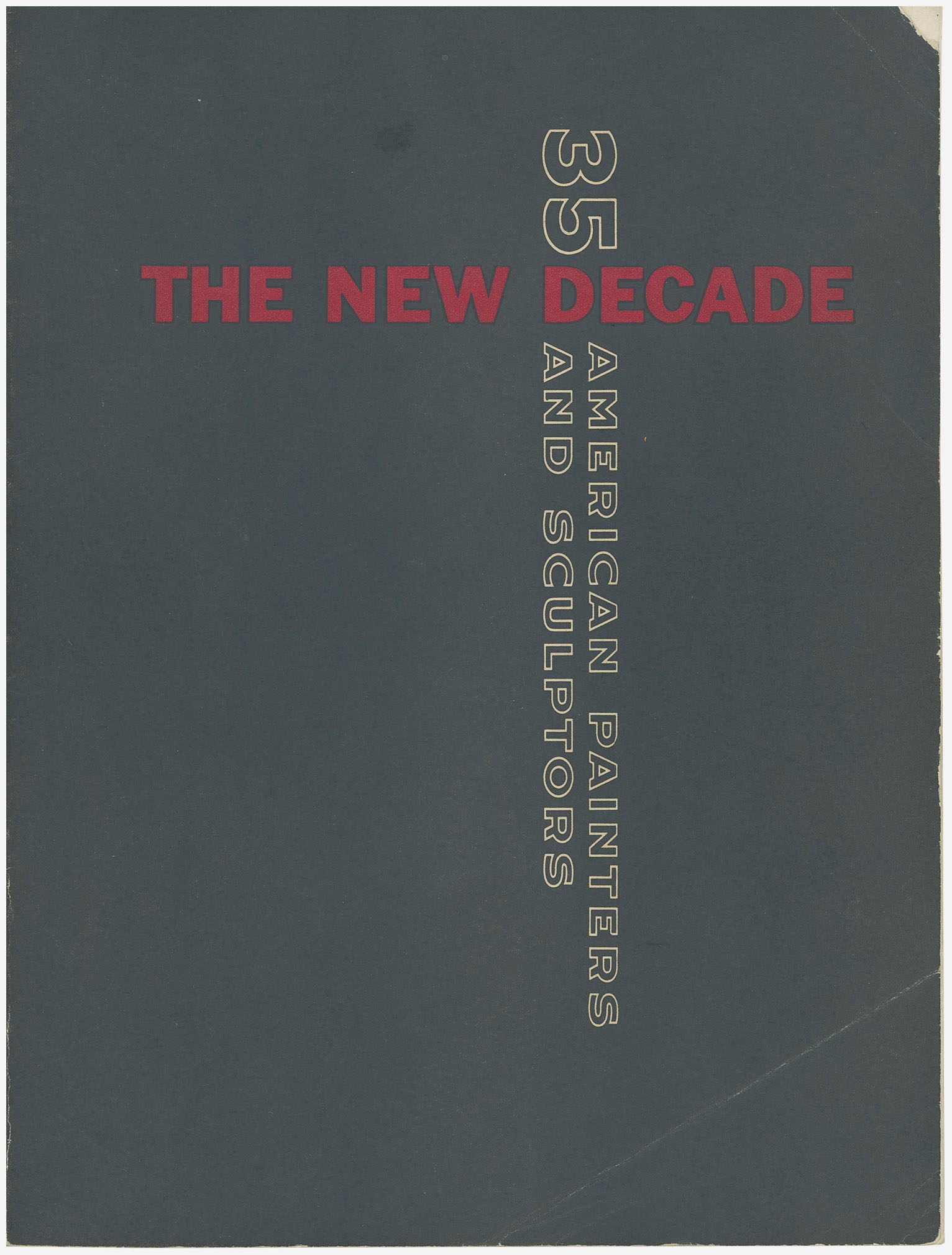
This statement was originally published in the catalogue for the exhibition The New Decade: 35 American Painters and Sculptors, which opened at the Whitney Museum of American Art in May 1955.
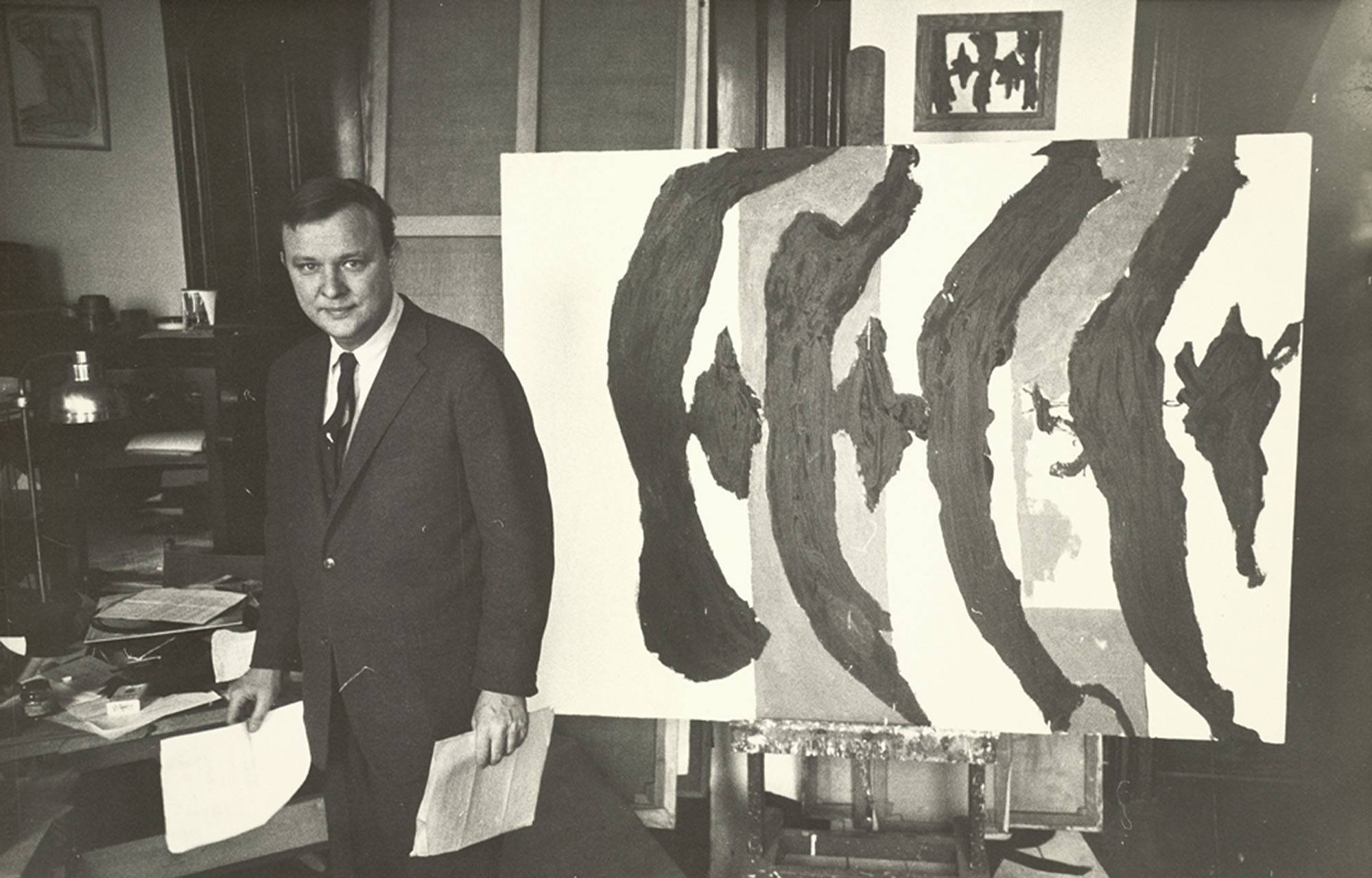
Robert Motherwell in his E. 94th St. studio with an early state of Wall Painting No. III
I never think of my pictures as ‘abstract,’ nor do those who live with them day by day—my wife and children, for example, or the profound and indomitable old French lady whose exile in New York has been enhanced by a miniature collection of them. I happen to think primarily in paint—this is the nature of a painter—just as musicians think in music. And nothing can be more concrete to a man than his own felt thought, his own thought feeling. I feel most real to myself in the studio, and resent any description of what transpires there as ‘abstract’—which nowadays no longer signifies ‘to select,’ but, instead, something remote from reality. From whose reality? And on what level?
If a painting does not make a human contact, it is nothing. But the audience is also responsible. I adore the old French lady because among my work she chooses those that specifically move her. Through pictures, our passions touch. Pictures are vehicles of passion, of all kinds and orders, not pretty luxuries like sports cars. In our society, the capacity to give and to receive passion is limited. For this reason, the act of painting is a deep human necessity, not the production of a hand-made commodity. I respect a collector who returned one of my ‘abstract’ pictures to the gallery, saying it was too tragic in feeling for her to be able to look at it every day. But somewhere there is a man with a tragic sense of life who loves that same picture, and I think he will find one day a way to have it. These are real human contacts, and I love painting that it can be a vehicle for human intercourse. In this solitary and apathetic society, the rituals are so often obsolete and corrupt, out of accord with what we really know and feel . . . True painting is a lot more than ‘picture-making.’ A man is neither a decoration nor an anecdote.

Robert Motherwell in his E. 94th St. studio with an early state of Wall Painting No. III
Read Next